TragikkK—in progress
Where did it come from?
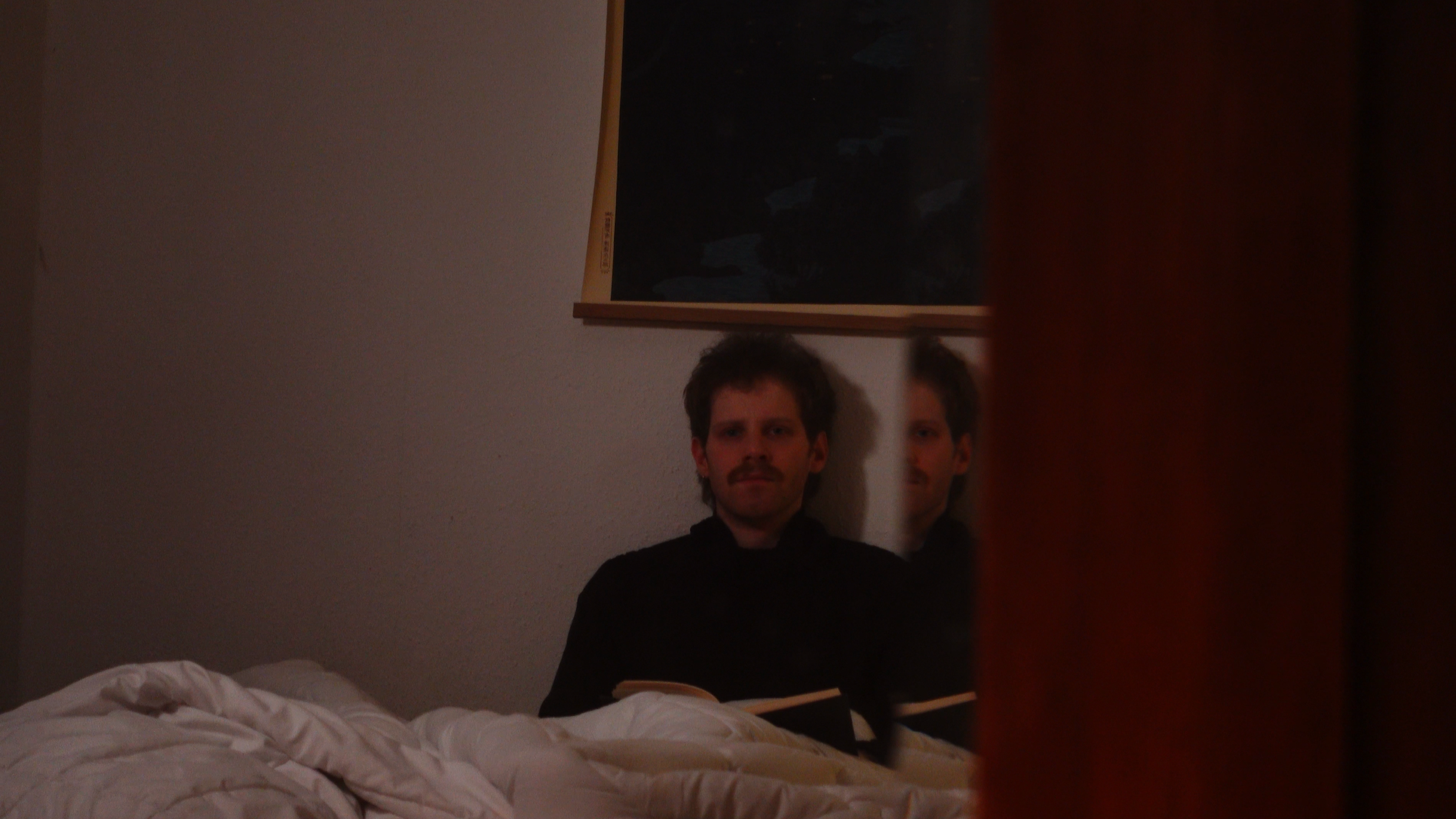
The idea for TragikkK has been working inside me for roughly three years of working bar/service jobs. The idea was to question society and reflect the way immigrants, or in general, marginalised people feel in gastronomy, serving white middle- to upper-class customers, and the conflict involved in those clashes. Of course, these conflicts would be mainly self-critical through the lens of the protagonist, who would eventually understand that all of the external factors reflect inner conflicts, which stem from external societal constructions that get stuck in the process of digesting them. An almost never-ending cycle. I was imagining a sort of personal narrative in similarity to GRISES PERMANENTES, but of course, less pitiful and much more conflicting with the external entities. But something happened along the way, a dream. I had a dream of my dear friend Calan, who played a character in my graduation film La Flor Inexistente. In the film, Calan played the character of the roommate and his double. The character reflected two versions of the same person: a sort of “good” which existed in the outside world, and the “bad” who existed in the dream world, a confrontational, straightforward version of the other. In my dream, I saw Calan sitting on a bar stool, alone, reading a book. I was looking at him as I floated in the air, much like a camera on a crane. I slowly got lowered and came closer to the book that he was reading; on the pages it was written: “Tragic”—followed by a dotted list of different tragic things. I felt a very distressing fear as I saw the page; a high-pitched scream started to growl, and I woke. I sadly couldn’t remember what the list was, and by processing the dream, I made my goal to try to decipher the list. It was obvious this was my next film, and the list would come through while I wrote it.
Not so long after, I lost a book. It was a very strange thing for me, mainly because the last time I saw it was on my bed while I read it. The next thing I knew, it was gone; it was a very strange book. The impact it had on me almost left me wondering about myself on a very deep level, so I made it the whole journey of the character in my new script. Jacob reads a book in a bar. He looks up, then down, and it disappears. He goes and asks the bartender, only to find himself on the other side. At the end of the film, the book would return, only for Jacob to find more questions about his existence and moral values.
TragikkK went from embodying the clash between the server and the guest, the marginalised and the privileged, to the relationship between us and society, between the inner self and the outer self, which in constant duel fights for owning a common identity. The film confronts the idea of what Bell Hooks called “Imperialist White Supremacist Capitalist Patriarchy”, which lives inside of each one of us, no matter how against it we are or become. The character went from being a marginalised person to an actual white privileged person to confront the white German society by showing them themselves. My idea evolved to represent them as both them and myself, not separate and portray them as a unified identity.
No matter how much we, in society, try to be aware and work, we will keep finding things that are completely terrifying inside ourselves. Our real selves experience a breakthrough between who we want to be and who we are programmed to be. The character goes through this understanding; he sees parts of himself that he didn’t know existed- the racist, sexist, white supremacist, capitalist, patriarchal side of himself- and for the first time, he faces it and tries to bond with it, to change it.
The film is meant to ask more questions than give answers, but at the same time, these introspective questions should give way to potential answers by reflecting on what could be done inside, which can allow these answers to appear, depending on the type of life one lives. TragikkK is meant to encapsulate feelings of discomfort through the clashes of different societies by going further than the common “bad” and “good” dynamic of relations. The film is meant to transform the so-called “good” into the “bad” and vice versa. The importance lies in the questions and the way we can create the answers, rather than a “logically easy” way out.