Script for a Short Film
Three Vampires are sent to the human world as punishment. There, like ticking bombs, everything they touch evokes powerful change. Their three lives are unrecognisable to one another until the three meet the same human. A man obsessed with using technology to control others. Their realities clash when they are all intertwined in the same event. The vampires learn about the light inside humans, and the human reaches for the darkness.
The script for Children of Kali is one of my latest writings. It continues to evolve every day, and its source was, yet again, winter in Berlin. My idea came from the constant vampires that I see and meet in this city, counting, of course, myself. The film is meant to bring the idea of darkness as a process into the light, and the way in as something perhaps scary and difficult. Here I also leave a fraction of the first ever idea for the film, as it is now worked more extensively in a slightly distinct direction, but it still carries the birth essence of the project.
Overview
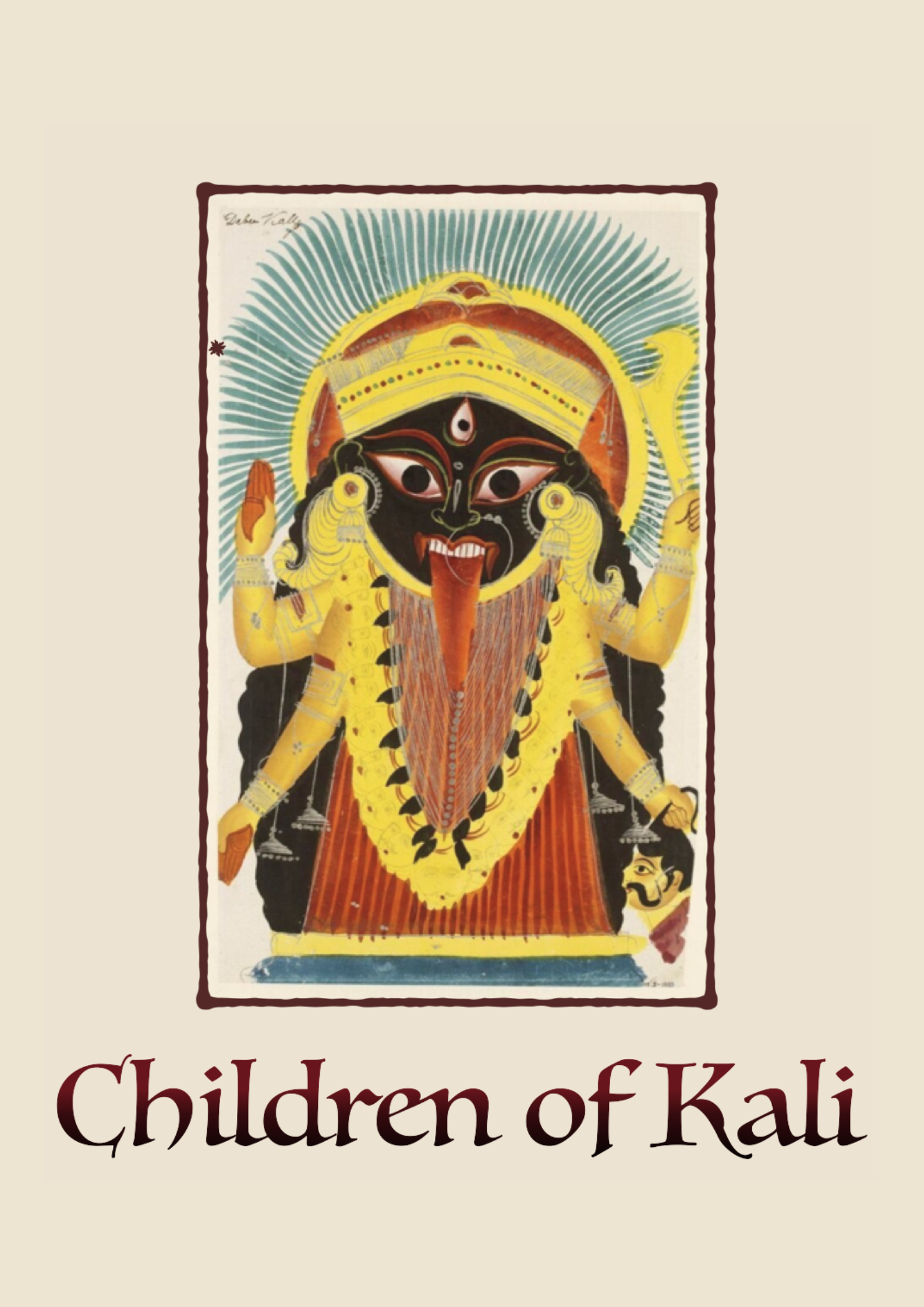
Children of Kali takes place in a world ruled by Kali, the goddess of destruction. Her children move through the world like vampires, feeding on the energy of those around them while struggling to find something within themselves. Luna, Marco and Dante are three characters whose lives are shaped by this cycle of consumption, loneliness and desire. When their paths cross, their individual descents into darkness become intertwined, forcing them to confront the ways they have learned to live at the expense of others. The story begins with Marco alone in an abstract darkness. Standing on his skateboard at the edge of an enormous ramp, he drops into it and begins to descend. The ramp seems endless. As the wind grows stronger, the darkness gradually consumes him until he disappears completely. We then enter Marco's room, where his relationship is coming to an end. Surrounded by decay and disorder, Marco struggles to understand himself and his inability to connect with another person. A dying pot of lilies becomes the only sign of life in the room. When his partner leaves, she leaves behind a ring, marking the final break between them. Marco remains alone. He tears a flower from the pot and consumes it, falling onto his couch as the world around him begins to transform. In a moment between hallucination and revelation, he experiences a strange sensation of light and describes it as “a thousand flowers opening inside my mind.”The screen turns white. Children of Kali. We return to Marco the following morning. His room is filled with the remnants of excess — empty food containers, alcohol, clutter, and the evidence of a life lived without restraint. Dante is there with him after spending the night together. Their interaction is casual and detached, revealing a relationship built more around consumption and physical closeness than genuine intimacy. When they leave the apartment, they walk in opposite directions. The story begins from there.
Understanding the Story
At its centre, Children of Kali is a story about destruction, desire and the ways people consume one another in order to fill something missing within themselves. Kali functions less as a literal character and more as a force governing the world of the film. Her children inherit a world in which destruction and creation are inseparable. They seek connection, pleasure, affection and meaning, but often obtain these things through consumption — taking energy from the people around them without knowing how to give anything back. Marco embodies this contradiction. He longs to be loved and understood, but at the same time struggles to allow himself to be vulnerable. His relationship ends with him admitting that he wonders what it would feel like to be loved rather than hide inside himself. His desire for connection exists alongside an inability to create it. The flower becomes an important symbol within this contradiction. The lilies in Marco's room are dying, just as his relationship and his sense of self appear to be deteriorating. Yet when Marco eats the flower, something changes. The act is destructive, but it also produces a strange vision of beauty and illumination. Destruction as a form of transformation is the film's thesis. The opening skateboard sequence introduces this idea before we understand Marco's world. He is constantly descending, moving deeper into an endless darkness, with no clear destination. The ramp becomes a physical representation of his psychological state: movement without escape, speed without direction. This relationship between movement and entrapment continues throughout the story. The characters move through rooms, streets and cities, but remain caught within their own patterns of behaviour. The film is also interested in excess. The characters continuously consume, but consumption never seems to satisfy them. Their relationships operate in a similar way. They seek other people for comfort, pleasure, validation or energy, but struggle to establish genuine intimacy. In this sense, the three characters become different manifestations of the same question: How do we connect with another person without consuming them? The darkness of the film therefore isn't simply about evil or hopelessness. It represents the internal spaces the characters have created around themselves — spaces built from isolation, desire, shame and the inability to communicate. Yet within that darkness there are moments of light. Kali, as a figure of destruction, is therefore not only a symbol of death. Destruction can also mean the destruction of an old identity, a relationship, a belief or a way of living. The characters must ultimately confront what they have destroyed to understand what they might become.
Why Children of Kali?
Kali is traditionally associated with destruction, death, transformation and the destruction of illusion. The title uses this mythology as a framework for a group of characters who seem to inherit these qualities. The “children” of Kali are not necessarily children in a literal sense. They are people shaped by a world of constant consumption and destruction. They are products of their surroundings, but they also reproduce those surroundings through their own actions. Luna, Marco and Dante each carry their own version of this darkness. They take from others because they are searching for something they cannot provide for themselves. Love becomes consumption. Desire becomes dependency. Pleasure becomes escape. To be a child of Kali is to exist within a process of destruction and rebirth. Something must be destroyed before something else can emerge. The characters may have to lose parts of themselves — their relationships, their habits, their identities or their illusions — before they can discover another way of existing. The film therefore asks whether darkness is something we simply live within, or whether it can become the environment from which we find our way towards light. Something is dying. And yet, somewhere inside the darkness, something is beginning to bloom.